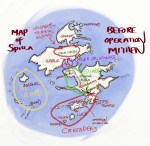
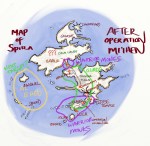
Yuna’s pilgrimage is a linear journey across a landscape, but the landscape isn’t static. Unknown to Yuna and friends (apart from perhaps Auron), they’re crossing a gameboard, and the boundaries are being redrawn around them.
[[SPOILERS from here on]] Above, I’ve shown the biggest shift in spheres of influence. Before and after Operation Mi’ihen, the Crusaders are nearly annihilated and lose all authority in the regions where they had been the major power.
As we can tell from piecing together various NPC comments, their downfall was engineered by Maester Kinoc. I believe Maester Seymour was not originally a party to Kinoc’s stratagem, but barged in at the last minute and partially usurped it, as I’ll explain below.
I was just revisiting this geopolitics question while editing the epic fic, and it finally hit me: LUCA IS ZANARKAND 2.0.
In the post above, I covered how, unknown to Yuna, a major power grab for control of the Luca-Djose corridor occurs just after she’s passed through the area, which one only discovers by backtracking and paying close attention. Kinoc was trying to take over Luca, the second most powerful city in Spira, plus the Luca-Djose-Moonflow corridor known as the Highroad. His plan worked only partway, because Seymour barged in. So, after Operation Mi’ihen, Kinoc’s warrior monks replaced the Crusaders defending Luca, and Seymour’s Guado replaced the Crusaders patrolling the Highroad.
But this isn’t the first time the maesters of Yevon have taken action against the Crusaders. When Yuna first sets foot on the Highroad out of Luca, Maechen is there to explain:
“This is a statue of Lord Mi’ihen. Eight centuries ago, he founded a legion known today as the Crusaders. In just a few short years after their founding, their ranks grew throughout Spira. The maesters of Yevon feared an uprising and accused them of rebellion. So Lord Mi’ihen walked along this very road to go face their charges and refute them. He succeeded in winning the maesters’ trust, and his legion became an arm of the Yevon clergy. It was then that Yevon gave them the name “Crusaders,” which they have kept ever since. And the rest is history.”
At this point in the game, Operation Mi’Ihen hasn’t happened yet; it’s still under preparation. So this is foreshadowing to the fact that if the Crusaders get too powerful, the maesters will crush them.
But it also shows the same north/south geopolitical division had existed for 800 years.
The statue of Lord Mi’ihen is at the southern part of the Mi’ihen Highroad, and there is a shrine to Lord Mi’ihen at the northern end where the name changes to Djose Highroad, just south of Djose. So while Crusader chapters formed all over Spira, his base of power – and therefore theirs – was in the south, far from Bevelle’s control.
Lord Mi’ihen realized the maesters were about to move against him, and abased himself to the maesters enough to avoid being crushed. When the Djose Chocobo Knights 800 years later arose as an elite division of the Crusaders, they didn’t have a shrewd political leader to save them.
But here’s what I hadn’t seen before: how this north/south conflict echoes the south/north conflict of Bevelle and Zanarkand.
Luca is the most modern-looking city in Spira, with a sphere theatrer and bars and shops. It’s a powerful, prosperous commercial port and blitzball mecca at the southern end of the world, as far as one can get from Bevelle. A largely unpopulated and difficult to traverse plain, the Thunder Plains, separating Bevelle and Luca.(Remember, Guadosalam only revently converted to Yevon, as the Ronso did; before that they would’ve been another barrier.) That unpopulated buffer zone mirrors the Calm Lands.
Luca is like Zanarkand at the southern end of the world, instead of the north. It’s not as advanced powerful as Zanarkand was, but then, thanks to Sin and the somewhat-enforced rules against machina, Bevelle isn’t what it was, either.
Lord Mi’ihen headed off Bevelle from attacking Luca as they had Zanarkand.
Later, Kinoc took over Luca instead of destroying it. But quite possibly Bevelle had intended to conquer, not destroy Zanarkand (although the weapons in that war were so powerful that destruction was more likely.)
In short, in the background of Yuna’s pilgrimage to Zanarkand, a dim echo of the Bevelle-Zanarkand conflict was repeating itself behind her.
Welcome back, viewers! Before the break, your intrepid news team braved fiends and Al Bhed to bring you a first exclusive look at the devastation wrought by Operation Mi’ihen!
Now let’s check out the buzz around Luca, the second greatest city in Spira! What lies in store for our marvelous metropolis now that its Crusader defenders have deserted their posts?
I’m thinking about Basch lately, which is unusual.
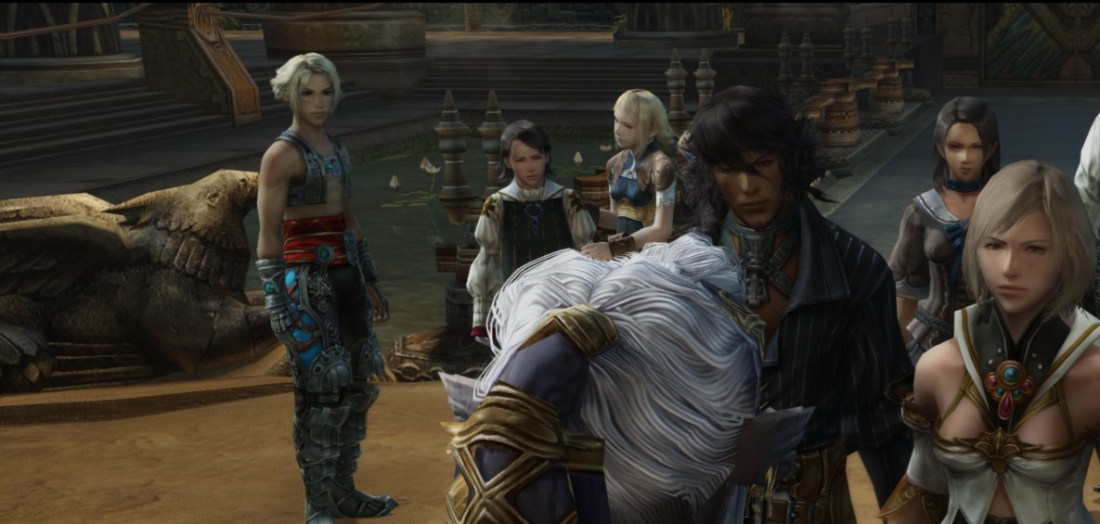
Basch is a Paladin (in the rpg way). He is loyal to the core. He lives for his duty. When the party is out of Barheim at last, he states that with his former allies or alone, he still bears his duty and he must fulfill it.
He devoted himself to Dalmasca and to Ashe. He always looks at her back, one step behind her. It takes time for Ashe to completely trust him again. Basch represents (her) failure. He was supposed to protect Rasler at the battle of Nalbina, but he ends up being the one to bring back his dead body. Basch is close to Ashe and the royal family. He is one of the few who attended the Prince’s funerals.
However, at this moment he is for Ashe “the one who failed”. And then he is fooled by the Empire and his brother when they try to save the King. The official version comes from Ondore, of course the Princess believes it. She thinks Basch is a traitor. And I think Basch feels guilt. For letting Dalmasca down. And as he says, he will do everything in his power to make it right.
As usual in this game, the characters’ development is not obvious. Apart from a few key moments (eg Vaan/Ashe scene in Jahara) the party rarely talks things through. We don’t have a Ashe/Basch scene where Ashe would verbally accept Basch’s presence. Basch only stay true to himself, and she slowly let him get back to his former role. Basch key scenes are mostly linked to his brother.
For Basch, being “True to himself” means he is honored to be Ashe’s sword, shield and advisor. And yet he takes no Pride in it. He has a strong sense of the hierarchy. True, the party becomes friends, family, they share a special link. Even between Ashe and Basch. However, Ashe will always be the ruler and Basch the knight. They trust each other and respect each other, which means they respect each other’s rank, strength and abilities.
When Balthier asks for the ring as a deposit, I’m sure Basch is not all so pleased about it. But he would never speak his mind at that very moment nor after. In no case Basch is a “dog” only following someone else’s orders (as his brother thinks), on the contrary he has a strong sense of free will, but his free will lead him to respect Ashe’s wish more than anything.
The scene with the ring is utterly important to Ashe’s development. She needs to achieve her goal, for her Kingdom, and that means sacrificing something personal, hurtful even if she still doesn’t know how to live without her husband’s presence. When Ashe agrees to give up on the ring, she is selfless, she does what a leader should do for their people.
I think Basch sees it. And even if he wouldn’t, he respects Ashe’s rank and free will by letting her do it. That doesn’t mean he would let her do anything she wants, but the ring is a private matter, not a Dalmasca one. After the scene with the Occurias, he is the one claiming “We are the arbiters of our Destiny. Your Highness, I am against it”.
Basch’s character is for me the perfect balance between the loyalty of a Paladin, and the independence of a Man. Because Final Fantasy XII characterization and story is bound to reality.
The reality of war, the reality of poverty, the reality of death, the reality of being powerless, but also the reality of devotion, friendship and goodbyes
Another important thing to notice : contrary to this post , Larsa is not dealing with the Gran Kiltias anymore. Ashe and Al-Cid are. Because here, Larsa is just a son who has just lost his father.
IT HAS JUST OCCURED TO ME THIS IS THE NABREUS DEADLANDS
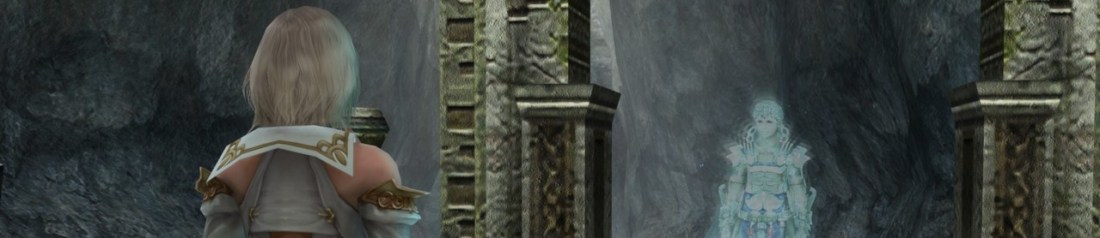
Ashe sees Rasler’s apparition for the first time in the Tomb of Raithwall and she’s so messed up she needs to come to her husband’s dead kingdom to think things through. THIS SCENE IS WAY MORE MEANINGFUL THAN I THOUGHT.
And just after this, the scene with Balthier and the ring happens.
I love Final Fantasy XII and one more reason I’ve found during my new game is how politically engaged it actually is. I will get in a serious mood with this meta.
Final fantasy XII is a Japanese game, created by Japanese people. And here you have a whole city (almost a kingdom), Nabudis, completely wiped of the map by one single blast. An entire population killed, erased in a second. It’s hard not to compare it to the atomic bombings of Hiroshima and Nagasaki.
Nabradia becomes Deadlands, infertile lands, infected by the myst, the same way radiations can infect land, food, water and people. In the game we have to fight zombies, who are canonically previous inhabitants of the city.
[spoilers ahead] One great approach of the game is how Vayne, the “villain” of the game may be right, wanting to get rid of “Gods” and let human beings be free.
However, his lust for the stones is wrong. The stones are the equivalent of a nuclear weapon. If we think about it, if we think of our own real world, Ashe’s choice is vital, decisive, and it really is a point of no return.
She has the equivalent of a nuclear weapon in her hands, and she decides not to use it.
There’s also some mirroring of Cold War era politics. The invasion of Nabradia is basically a proxy war between Arcadia and Rozzaria because the manga reveals that Vayne purposely provoked a civil war (between people who wanted remain allied with Dalmasca thus staying neutral, and those who wanted to ally with Rozzaria). Thus having a legitimate excuse to invade, and that would provoke Rozzaria to send troops and aide to the faction they supported.
Another example of a sort of proxy war are the events leading to the final battle, where the Rozzarians assisting the Bhujerban Resistance invade Archadian airspace, leading him to deploy The Bahamut as a show of force.
Vayne’s modus operandi heavily resembles realpolitik, where every political and diplomatic action taken is based on the current circumstances, rather than a specific and precise ideology. Like if a country supported a cruel dictator, because it lead to stability and it would stop the latter from allying with their enemy. For him morals and ideology don’t matter, just results.
Add in a Cuban missile crisis parallel, and a magic space race and you have the Cold War but with magick.
Vaan – of a brighter disposition and optimistic outlook – coming to terms with his grief and deciding to no longer run away from his past while standing under the night sky, and Balthier – of a shuttered disposition and cynical outlook – coming to terms with what it really means to be a leading man and deciding to no longer run away from his past while under the sunny sky, further adds to the both timelessly classic and romantically tragic sun-moon( /shooting star) dichotomy of the BalVaan ship. In this essay I will
Hmm…I always interpreted Balthier breaking away from his past, while Vaan embraced his, came to peace with his. Maybe I just saw things funny.
Balthier does embrace his past because he saves the day by being a machinist like his father – we watch him change a fuse, just like he showed Vaan in Barheim at the beginning. Many characters are running from their pasts, but all of them confront it as the story goes on.
I’m not sure how Balthier being a machinist has anything to do with accepting his past. I mean, he was a machinist and pilot already. It may be something they have in common but Balthier never denied his passion for mechanics.
The parallel between Vaan and Balthier is nice though !
Vaan – of a brighter disposition and optimistic outlook – coming to terms with his grief and deciding to no longer run away from his past while standing under the night sky, and Balthier – of a shuttered disposition and cynical outlook – coming to terms with what it really means to be a leading man and deciding to no longer run away from his past while under the sunny sky, further adds to the both timelessly classic and romantically tragic sun-moon( /shooting star) dichotomy of the BalVaan ship. In this essay I will
Hmm…I always interpreted Balthier breaking away from his past, while Vaan embraced his, came to peace with his. Maybe I just saw things funny.
I think you got a point ! Clearly Vaan accepts what happened two years ago and he is ready to live with it.
It’s more difficult to analyze Balthier because who he was in Archades is up to our subjective understanding of the character.
Him running away from Archades was his way to say No to his father. Like, he was physically away from him, but still highly ashamed and confused. He doesn’t want to face him. And he doesn’t want anyone to know who he was. He may live however he wants with Fran, but he avoids anything linked to Archadia and his father. He does say something like “if I knew what the stone was I wouldn’t have been so desperate to get my hands on it”
When he is finally ready to do so, he can show to Cid “this is who I am”. Not a Judge, not a puppet, I am Balthier. Of course Balthier’s feelings are still mixed, he still cares about his father, but he decides not to let his past guide his actions.
Vaan – of a brighter disposition and optimistic outlook – coming to terms with his grief and deciding to no longer run away from his past while standing under the night sky, and Balthier – of a shuttered disposition and cynical outlook – coming to terms with what it really means to be a leading man and deciding to no longer run away from his past while under the sunny sky, further adds to the both timelessly classic and romantically tragic sun-moon( /shooting star) dichotomy of the BalVaan ship. In this essay I will
I’ll repeat myself but I just love how Vaan is the sunny personality but confess all of this in the intimacy of the night, while Balthier with his moon personality does it under a bright sunlight.
But both do it discreetly to Ashe and they both help her grow step by step
Serious meta
I love Final Fantasy XII and one more reason I’ve found during my new game is how politically engaged it actually is. I will get in a serious mood with this meta.
Final fantasy XII is a Japanese game, created by Japanese people. And here you have a whole city (almost a kingdom), Nabudis, completely wiped of the map by one single blast. An entire population killed, erased in a second. It’s hard not to compare it to the atomic bombings of Hiroshima and Nagasaki.
Nabradia becomes Deadlands, infertile lands, infected by the myst, the same way radiations can infect land, food, water and people. In the game we have to fight zombies, who are canonically previous inhabitants of the city.
[spoilers ahead] One great approach of the game is how Vayne, the “villain” of the game may be right, wanting to get rid of “Gods” and let human beings be free.
However, his lust for the stones is wrong. The stones are the equivalent of a nuclear weapon. If we think about it, if we think of our own real world, Ashe’s choice is vital, decisive, and it really is a point of no return.
She has the equivalent of a nuclear weapon in her hands, and she decides not to use it.